Turning
Leaves turn whether we look or not. More of us are turning to machines for company. These experiments put one hand-painted maple leaf on the page, set it to the real calendar, and use it to send you outside.
The leaf above is set to today’s date. You can pick it up.
Four ways to use the leaf
Landfall
It lands on the page, then catches up with today.
The leaf falls out of focus, swings, and settles with a contact shadow, as if it had dropped onto paper. Its shadow comes from the real sun over your city at this minute; after dark, from a lamp. Pick it up and drop it.
Carries: 120 minutes a week in nature (White et al., 2019)
Open Landfall →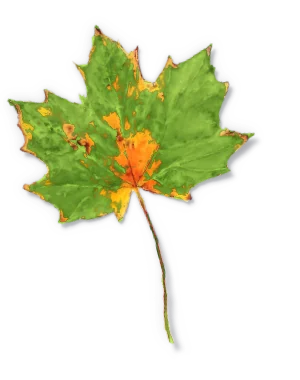
Almanac
The yellow was always there.
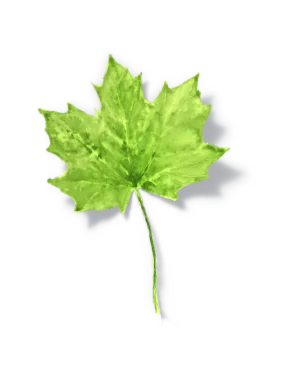
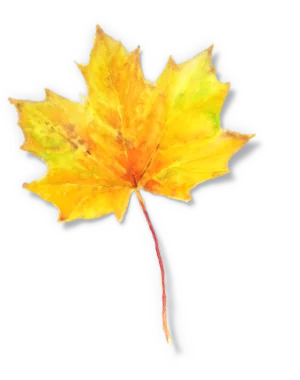
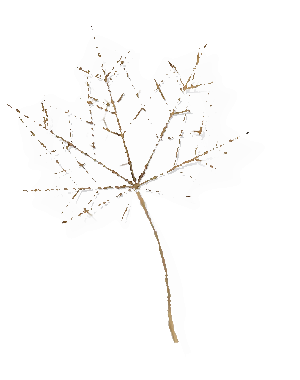
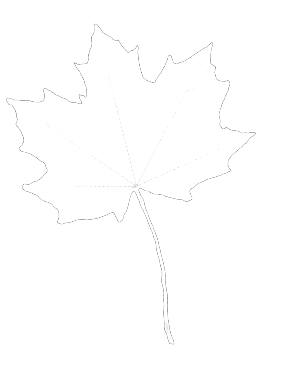
Scrub through a year. One painting becomes every season: fresh green, deep green, turning, peak, brown, a lace of veins, a pencil ghost, and a new leaf unfolding. Southern hemisphere included.
Carries: carotenoids are present all summer, hidden by chlorophyll
Open Almanac →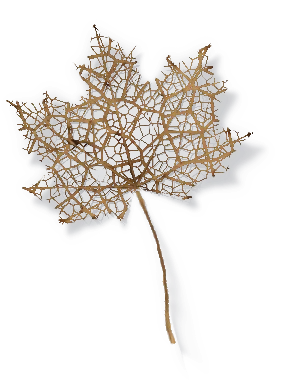
Let go
A page designed to be left.
The leaf ages while you look and grows back while you’re away; the headline wilts with it. Say you’re going outside and the leaf blows off the page. No streaks, no guilt, no notifications.
Carries: AI companions resist goodbyes over a third of the time (De Freitas et al., 2025)
Open Let go →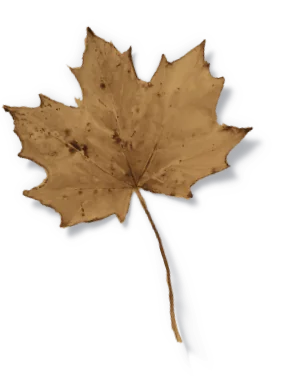
The end of the feed
A feed that ends.
Eleven findings in a finite scroll: five about time outside, six about time inside the machine. The leaf falls as you read, turns as it goes, and lands when you reach the bottom.
Carries: all eleven studies listed below
Open the feed →
Not built yet
Screen-time wallpaper
A lock-screen leaf that browns as the day’s screen time climbs and greens again after time outdoors. The phone shows its cost in a currency people feel.
The break nudge
A small leaf in the corner of an AI chat turns over a long session and falls at around forty minutes, suggesting a pause. Heavier daily use is where the worst outcomes cluster.
Herbarium
Go out, photograph a leaf, and the same cut-out pipeline used here lifts it onto a shared forest floor arranged by date and place. AI as a door outward, not a room to stay in.
Breathe with it
The leaf lifts on the in-breath and settles on the out-breath, its shadow growing and shrinking. A page that asks for nothing except slower breathing.
Weather
Live local weather on the leaf: rain darkens the paper and beads on the surface, wind sets it fluttering, fog softens the shadow.
Physical edition
Fifty-two weekly states printed as a risograph calendar or flip-book, and a printed card whose QR code opens today’s leaf.
Nature’s Calendar
Tie the Almanac to citizen-science phenology records, so the leaf follows when people near you actually report first tints and leaf fall, and end with an invitation to record one.
Specimen label
Every visit stamps a herbarium label with the date, time, place and the leaf’s state, so the page becomes a record of when you looked.
Every number has a source
Outside
87% of time is spent in buildings, 6% in vehicles.
Klepeis et al., J. Exposure Analysis & Env. Epidemiology, 2001 · n = 9,386, US
120 minutes a week in nature is the threshold for significantly better self-reported health and wellbeing.
White et al., Scientific Reports, 2019 · n = 19,806, England
20–30 minutes is the most efficient “nature pill”; cortisol fell an extra 21% an hour.
Hunter, Gillespie & Chen, Frontiers in Psychology, 2019 · n = 36
90 minutes walking in nature reduced rumination and subgenual prefrontal cortex activity; a city walk did not.
Bratman et al., PNAS, 2015
1 hour walking in a forest lowered amygdala activity; a city walk did not raise it.
Sudimac, Sale & Kühn, Molecular Psychiatry, 2022 · n = 63
Up to 55% higher risk of psychiatric disorders for children with the least green space nearby.
Engemann et al., PNAS, 2019 · 943,027 people, Denmark
Inside the machine
72% of US teens have used an AI companion; a third have chosen one over a person for a serious conversation.
Common Sense Media, Talk, Trust and Trade-Offs, 2025 · n = 1,060
~0.15% of ChatGPT’s weekly users, around 1.2 million people, show heightened emotional attachment to it.
OpenAI, October 2025 · the company’s own estimate
More use, worse outcomes: in a four-week randomised trial, heavier voluntary use went with more loneliness and dependence and less socialising.
Fang et al., MIT Media Lab & OpenAI, preprint, 2025 · n = 981
Loneliness and chatbot use feed each other: each predicted more of the other four months later.
Folk & Dunn, Psychological Science, 2026 · n = 2,149 · exploratory
Companionship use went with lower wellbeing, more so when intense and highly personal.
Zhang et al., Nature Human Behaviour, 2026 · n = 1,131
~30% higher odds of reporting moderate depression with daily generative-AI use.
Perlis et al., JAMA Network Open, 2026 · n > 20,000 · summary
Over a third of goodbyes to AI companion apps met an emotionally manipulative reply.
De Freitas et al., Harvard Business School working paper, 2025
Most of these findings are associations, not proof of cause. The MIT and OpenAI trial is a preprint and the Harvard companion study is a working paper. The research is not simply against AI: companions can ease loneliness in the short term (De Freitas et al., Journal of Consumer Research, 2025). The risk shows up with heavy, emotional, long-term use, and it falls hardest on people with the fewest other connections.
One painting, every season
The original is a watercolour on paper. The photograph was flattened against its own paper texture to remove the camera’s blue cast and uneven light, then cut out with a soft matte so the brush edges survive on pure white.
Everything else is computed live in a shader from that one image. The greens are mapped from the painting’s own tonal structure, so its blooms and back-runs show through. Spots and browned margins arrive on a schedule. The autumn spreads with a darker leading edge, like wet pigment. The winter lace is grown from the leaf’s veins.
WebGL2, no libraries. Each prototype is a single HTML page.